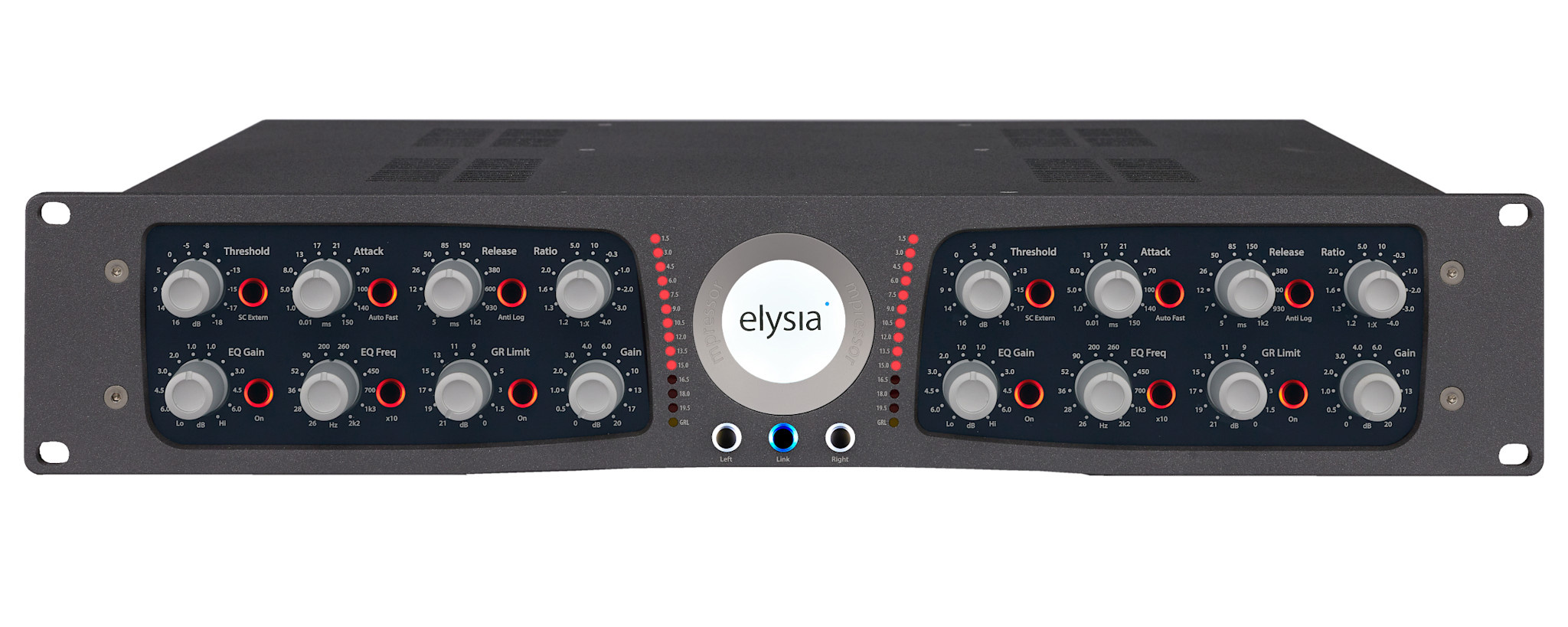
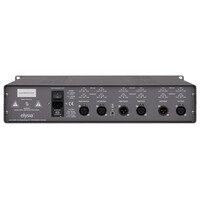
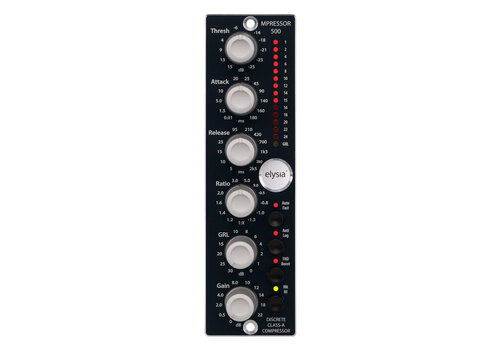
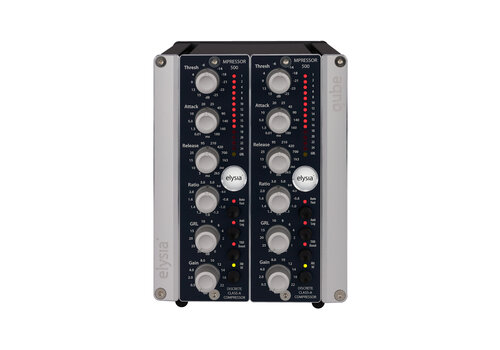
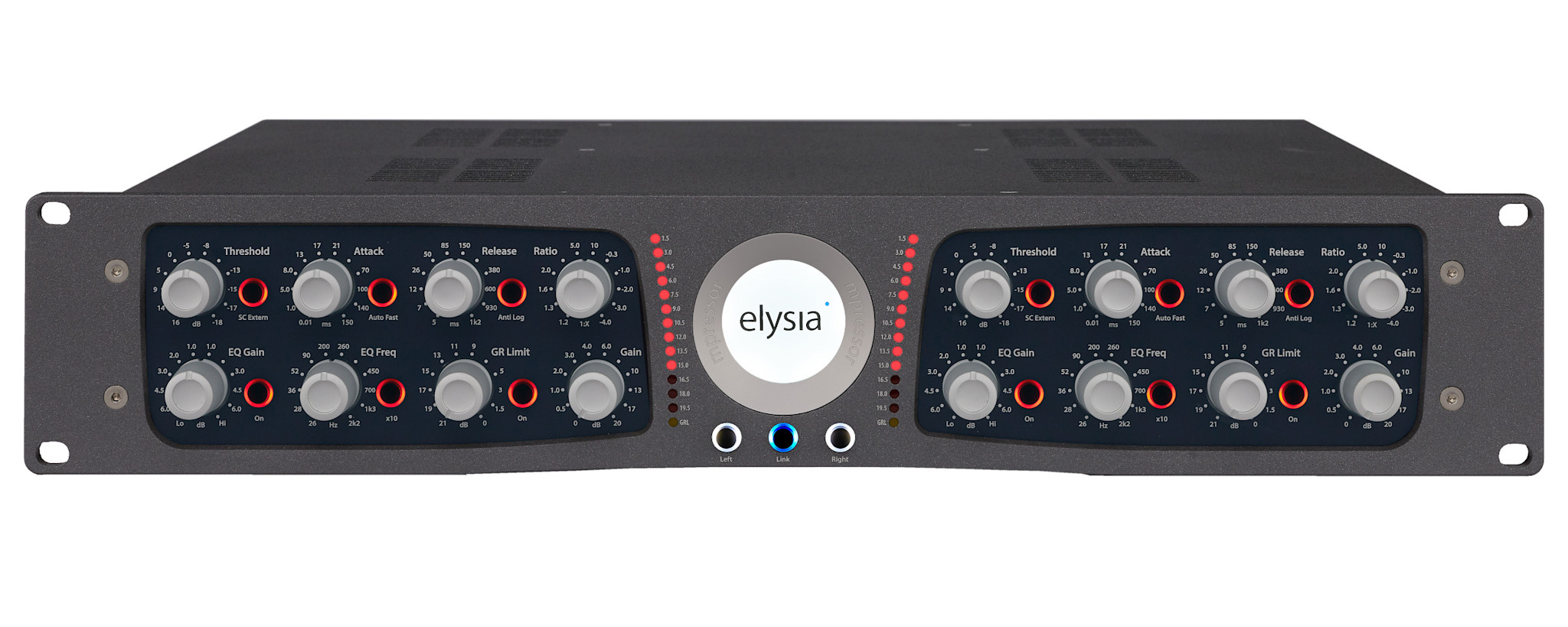
Creative compressor with Stereo and Dual-Mono operation
Anti-Log release enabling creative styles
Tilt EQ available on 19" rack version
Hard Knee compressor for a different characteristic
Class-A Technology with discrete circuit designs
Gain Reduction Limiter with precise control over compression
Negative ratios for groovy compression effects
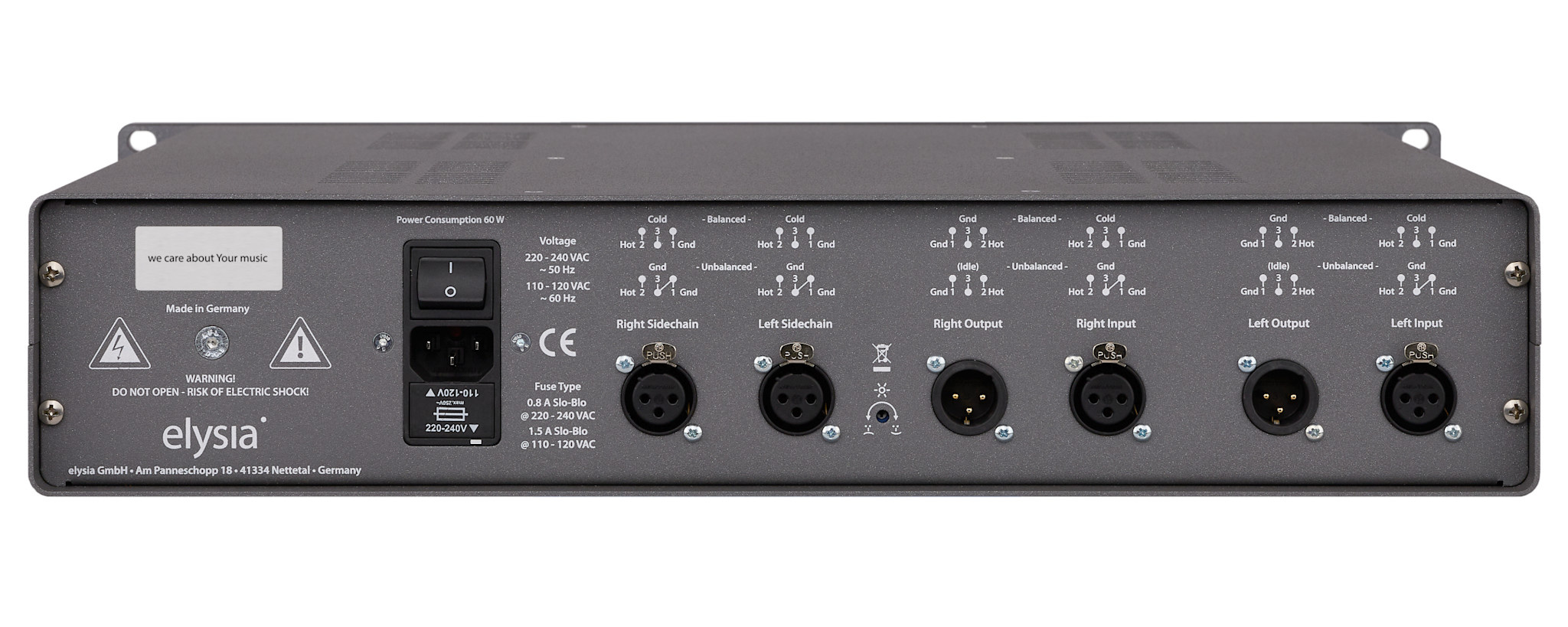
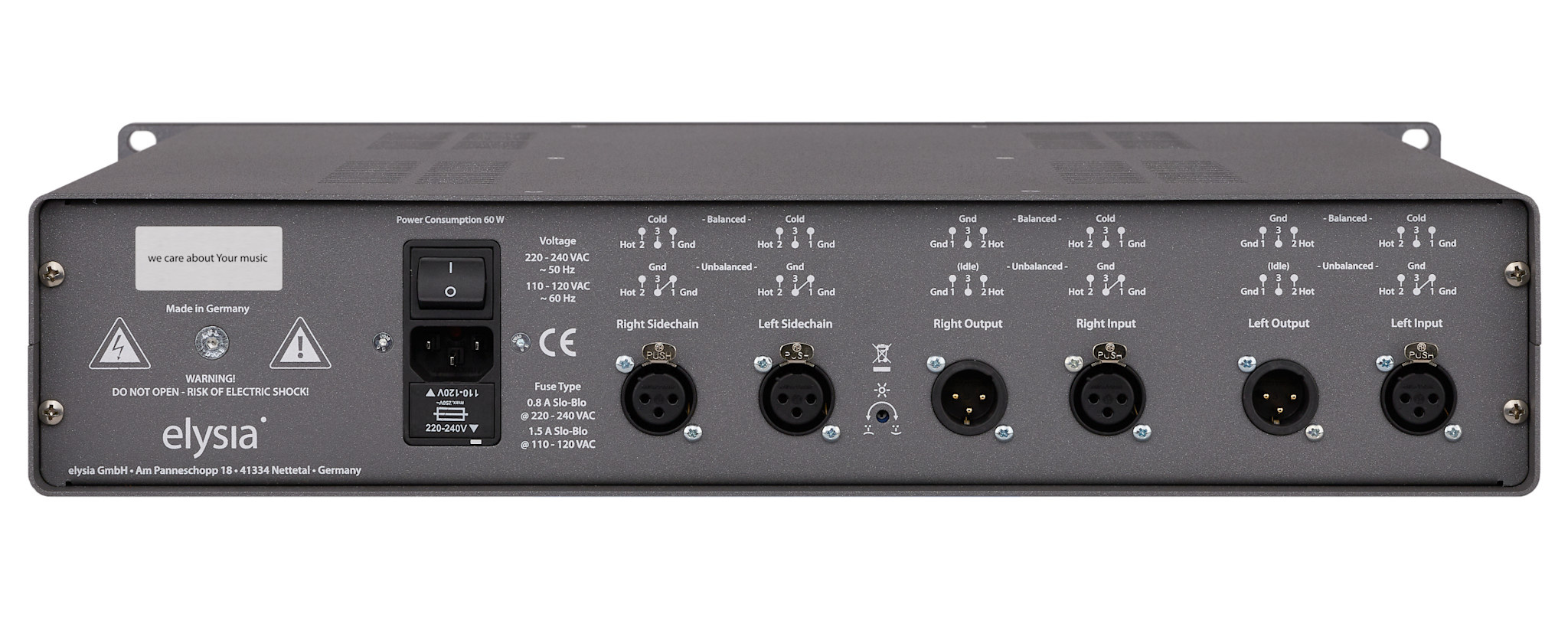
External Sidechain available on 19" rack version
Anti Log Release
It is characteristic of a logarithmic release that the time constant shortens when the amount of gain reduction increases. The advantage of this behavior is that short and loud peaks (e.g. drums) have a fast release time, while the remaining material is processed with a slower release time.
But if intentionally striking and creative compression is the goal, it definitely makes sense to turn things upside down. In the Anti Log mode of the mpressor the curve behaves just the other way round: If the threshold value is passed and compression starts, the release time will be longer at the beginning. If the input signal starts to decline, however, the release time will become faster as a result.
Auto Fast
Choosing the right time settings is very important, but depending on the dynamic progress of the source material this can be a difficult task – no matter if single tracks or complete mixes are processed. If a very short attack time is chosen, the compressor is able to catch the short peaks, but on the other hand the sustaining signal will also be processed, which might result in audible distortion. Longer settings reduce distortion significantly, but then the compressor is too slow for catching fast impulses. This is where the Auto Fast function comes into play. For example, if you set the attack to 80 ms and then engage the Auto Fast mode, the attack time will be shortened automatically on fast and loud signal impulses. The compressor reduces the signal quickly and prevents it from slipping through.
Negative Ratios
Negative ratios – what exactly does this mean? To get a better understanding of this function, it makes sense to realize what the ratio control of a ‘normal’ compressor does:
1:1 The signal remains linear, there is no compression going on.
1:2 After crossing the threshold, an increase of 2 dB at the input will be compressed to an increase of 1 dB at the output
1:∞ After crossing the threshold, the output signal is constantly held at the threshold level without reacting to further increases at the input (limiter).
At a negative ratio, the characteristic curve bends and returns back down after crossing the threshold. The louder the input signal, the lower the output signal – perfect for groovy compression effects. To get a grip on the extreme ‘destruction’ this can cause, engaging the Gain Reduction Limiter is just the right idea.
External Sidechain
The external sidechain enables the compressor to control its processing totally independent from the audio material running through it. If the SC Extern switch is active, compression will not be triggered by the signals from the regular audio inputs anymore, but by different signals which are fed into the additional sidechain input connectors.
If, for example, a duplicate of the input signal is processed with an equalizer and then fed into the sidechain input, the result will be frequency-dependent compression. Another example is to send the bass drum of a drum machine into the sidechain input in order to achieve nice groovy compression that is pumping in sync with the music.
The external sidechain inputs are equipped with a high pass filter that has its cut-off frequency at 80 Hz with 6 dB per octave. This has been done in order to reduce the influence of the low frequencies on overall compression by a certain amount in order to keep the effect as balanced as possible.
Gain Reduction Limiter
This limiter is not placed in the audio path where you would usually find it, but in the control path of the compressor. When it is activated, it limits the control voltage according to the setting of the GR Limit controller. This means: No matter how high the input level might become – the amount of gain reduction will never exceed the value which you have set.
For comparison, imagine a fader on a mixing console with your hand moving the fader to ‘play compressor’. If now the fader was limited by a piece of duct tape at -10 dB, for example, it could only reduce the signal up to this value. If the input level dropped below this limit, the fader would be moved up correspondingly.
However, if the input signal got even louder, the fader could not be moved down any further because of the duct tape limit, and then the output signal would become louder again in correspondence with the input signal.
Tilt EQ
This filter is a specialist in changing the overall sonic character of a signal with ease. It features two controllers per channel and is capable of producing convincing results flexibly in no time at all. Whenever a classic shelving filter would be too limited and a fully parametric filter would be too much, the Niveau Filter is the perfect tool.
Its main function is to change the proportions between high and low frequencies. The principle is quite similar to a pair of scales: Dependent on the gain setting around a variable center frequency, the high frequencies are boosted whereas the low frequencies are attenuated (or vice versa).
By simultaneously boosting and cutting the selected frequency areas, it is much easier to influence the character of a track (‚bright‘ vs. ‚dark‘) compared to using other types of equalizers. The center frequency can be shifted continuously between 26 Hz and 2.2 kHz or between 260 Hz and 22 kHz respectively (when the x10 switch is activated).
Transconductance Amplifier
A crucial part in the development process of a compressor is to design its control element that reduces the audio signal controlled by voltage. This is also where the main technological concepts show the most obvious differences.
The mpressor uses elysia’s fully discrete and temperature compensated Transconductance Amplifier (TCA). A differential pair of transistors that uses a modulated current source to affect the amount of amplification builds the core of this module. A few extra transistors were added in order to further decrease noise and unwanted influences of the control voltage.
The benefits of discrete electronics design can once again show their strengths by tailoring the sound via the concept of the circuitry and the choice of components. A further advantage of the TCA topology is the very fast response to the control voltage. This is the basis for a compressor that can even handle rapid changes in dynamics and which provides extremely fast time constants.
T12 Heater
Some delicate parts of the discrete circuitry can be influenced by the surrounding temperature easily. The main reason for this circumstance is the single transistors that can react very sensitively to variations in temperature (which can – depending on the place of installation and operating time – happen by all means).
With the T12 Heater elysia presents a system that arranges constant conditions and reduces the thermal fluctuation to a minimum. This system was inspired by high-precision measuring instruments. It features up to 12 discrete transistors in a massive copper ring that is warmed up to a definite temperature.
Once the system has reached its working temperature, it only needs little current to keep it at the same level. An electronic control circuit is responsible for a low variance of only a few degrees. The procedure is known from high end tube gear: the mpressor should be granted a short warm-up time to experience it absolute top form.
Creative compressor with Stereo and Dual-Mono operation
Anti-Log release enabling creative styles
Tilt EQ available on 19" rack version
Hard Knee compressor for a different characteristic
Class-A Technology with discrete circuit designs
Gain Reduction Limiter with precise control over compression
Negative ratios for groovy compression effects
External Sidechain available on 19" rack version
Anti Log Release
It is characteristic of a logarithmic release that the time constant shortens when the amount of gain reduction increases. The advantage of this behavior is that short and loud peaks (e.g. drums) have a fast release time, while the remaining material is processed with a slower release time.
But if intentionally striking and creative compression is the goal, it definitely makes sense to turn things upside down. In the Anti Log mode of the mpressor the curve behaves just the other way round: If the threshold value is passed and compression starts, the release time will be longer at the beginning. If the input signal starts to decline, however, the release time will become faster as a result.
Auto Fast
Choosing the right time settings is very important, but depending on the dynamic progress of the source material this can be a difficult task – no matter if single tracks or complete mixes are processed. If a very short attack time is chosen, the compressor is able to catch the short peaks, but on the other hand the sustaining signal will also be processed, which might result in audible distortion. Longer settings reduce distortion significantly, but then the compressor is too slow for catching fast impulses. This is where the Auto Fast function comes into play. For example, if you set the attack to 80 ms and then engage the Auto Fast mode, the attack time will be shortened automatically on fast and loud signal impulses. The compressor reduces the signal quickly and prevents it from slipping through.
Negative Ratios
Negative ratios – what exactly does this mean? To get a better understanding of this function, it makes sense to realize what the ratio control of a ‘normal’ compressor does:
1:1 The signal remains linear, there is no compression going on.
1:2 After crossing the threshold, an increase of 2 dB at the input will be compressed to an increase of 1 dB at the output
1:∞ After crossing the threshold, the output signal is constantly held at the threshold level without reacting to further increases at the input (limiter).
At a negative ratio, the characteristic curve bends and returns back down after crossing the threshold. The louder the input signal, the lower the output signal – perfect for groovy compression effects. To get a grip on the extreme ‘destruction’ this can cause, engaging the Gain Reduction Limiter is just the right idea.
External Sidechain
The external sidechain enables the compressor to control its processing totally independent from the audio material running through it. If the SC Extern switch is active, compression will not be triggered by the signals from the regular audio inputs anymore, but by different signals which are fed into the additional sidechain input connectors.
If, for example, a duplicate of the input signal is processed with an equalizer and then fed into the sidechain input, the result will be frequency-dependent compression. Another example is to send the bass drum of a drum machine into the sidechain input in order to achieve nice groovy compression that is pumping in sync with the music.
The external sidechain inputs are equipped with a high pass filter that has its cut-off frequency at 80 Hz with 6 dB per octave. This has been done in order to reduce the influence of the low frequencies on overall compression by a certain amount in order to keep the effect as balanced as possible.
Gain Reduction Limiter
This limiter is not placed in the audio path where you would usually find it, but in the control path of the compressor. When it is activated, it limits the control voltage according to the setting of the GR Limit controller. This means: No matter how high the input level might become – the amount of gain reduction will never exceed the value which you have set.
For comparison, imagine a fader on a mixing console with your hand moving the fader to ‘play compressor’. If now the fader was limited by a piece of duct tape at -10 dB, for example, it could only reduce the signal up to this value. If the input level dropped below this limit, the fader would be moved up correspondingly.
However, if the input signal got even louder, the fader could not be moved down any further because of the duct tape limit, and then the output signal would become louder again in correspondence with the input signal.
Tilt EQ
This filter is a specialist in changing the overall sonic character of a signal with ease. It features two controllers per channel and is capable of producing convincing results flexibly in no time at all. Whenever a classic shelving filter would be too limited and a fully parametric filter would be too much, the Niveau Filter is the perfect tool.
Its main function is to change the proportions between high and low frequencies. The principle is quite similar to a pair of scales: Dependent on the gain setting around a variable center frequency, the high frequencies are boosted whereas the low frequencies are attenuated (or vice versa).
By simultaneously boosting and cutting the selected frequency areas, it is much easier to influence the character of a track (‚bright‘ vs. ‚dark‘) compared to using other types of equalizers. The center frequency can be shifted continuously between 26 Hz and 2.2 kHz or between 260 Hz and 22 kHz respectively (when the x10 switch is activated).
Transconductance Amplifier
A crucial part in the development process of a compressor is to design its control element that reduces the audio signal controlled by voltage. This is also where the main technological concepts show the most obvious differences.
The mpressor uses elysia’s fully discrete and temperature compensated Transconductance Amplifier (TCA). A differential pair of transistors that uses a modulated current source to affect the amount of amplification builds the core of this module. A few extra transistors were added in order to further decrease noise and unwanted influences of the control voltage.
The benefits of discrete electronics design can once again show their strengths by tailoring the sound via the concept of the circuitry and the choice of components. A further advantage of the TCA topology is the very fast response to the control voltage. This is the basis for a compressor that can even handle rapid changes in dynamics and which provides extremely fast time constants.
T12 Heater
Some delicate parts of the discrete circuitry can be influenced by the surrounding temperature easily. The main reason for this circumstance is the single transistors that can react very sensitively to variations in temperature (which can – depending on the place of installation and operating time – happen by all means).
With the T12 Heater elysia presents a system that arranges constant conditions and reduces the thermal fluctuation to a minimum. This system was inspired by high-precision measuring instruments. It features up to 12 discrete transistors in a massive copper ring that is warmed up to a definite temperature.
Once the system has reached its working temperature, it only needs little current to keep it at the same level. An electronic control circuit is responsible for a low variance of only a few degrees. The procedure is known from high end tube gear: the mpressor should be granted a short warm-up time to experience it absolute top form.